Weekly NIL Ledger Newsletter | 1/26-1/31
Introduction
This week in NIL and college sports law highlights how unstable the current system still is. A major NIL contract dispute ended in settlement, enforcement bodies are beginning to assert real authority, and states are expanding NIL rights beyond college athletics. Across all of it, the same issue keeps resurfacing. Schools want structure and predictability, but the legal framework continues to treat athletes inconsistently.
The Mensah Case and the Limits of NIL Contract Enforcement
What happened
The Darian Mensah dispute began when the Duke quarterback entered the transfer portal near the end of the January window. Duke responded by filing a lawsuit in state court seeking to enforce a multi-year NIL and revenue-sharing agreement. Duke argued that Mensah breached the contract by attempting to transfer and that the agreement granted Duke exclusive NIL rights tied to his participation as its quarterback. Duke also sought arbitration and injunctive relief to prevent him from enrolling elsewhere.
Mensah’s position was that he was not an employee and remained a student. Because of that, he argued he retained the right to unenroll, enter the transfer portal, and terminate any NIL relationship connected to his enrollment. That framing exposed the central conflict in the case. Duke treated the agreement like an employment contract, while Mensah relied on the fact that his legal relationship with the school was still educational.
Rather than allowing the court to rule on enforceability, the parties settled this week. Duke dropped the lawsuit, and Mensah was cleared to transfer. Reports indicated the resolution functioned similarly to a buyout, though the financial terms were not disclosed. Mensah is now expected to play at Miami. Most importantly, the settlement avoided a judicial ruling on whether the NIL contract itself was enforceable.
Why the settlement matters
The importance of the Mensah settlement lies in what was left undecided. The court did not rule on whether schools can bind non-employee athletes to multi-year NIL agreements. It did not rule on whether arbitration clauses in those agreements are enforceable. And it did not rule on whether NIL contracts can justify blocking transfers through injunctions.
By settling, both sides avoided creating a precedent. Schools avoided the risk of weakening NIL contract enforcement nationwide. Athletes avoided a ruling that could have encouraged aggressive litigation against transfers. The result preserved uncertainty but also demonstrated how difficult it is to rely on courts for NIL enforcement.
Reaction across college sports
Duke officials emphasized that NIL agreements are intended to create stability and that contractual commitments should matter, while also acknowledging that resolving the dispute efficiently was important for all parties.
Mensah’s representatives described the outcome as fair and mutually agreeable, emphasizing that prolonged litigation would not benefit the athlete.
Administrators at other Power Conference programs reacted more cautiously. Several athletic department officials, speaking anonymously, questioned whether NIL contracts can realistically provide long-term roster stability. One conference administrator noted that once a player enters the transfer portal, schools often face a practical choice between settling or losing both the player and the opportunity to replace him. A Big 12 personnel executive described the case as further proof that NIL contracts lack real enforcement power when portal leverage is involved.
The overarching reaction was consistent. Schools want enforceable commitments, but many privately acknowledge that the current NIL framework does not provide reliable tools to achieve that goal.
From NIL contracts to employment questions
The Mensah dispute quickly became part of a broader conversation about athlete status. NIL and revenue-sharing agreements increasingly resemble employment contracts. They include multi-year terms, exclusivity provisions, performance expectations, and arbitration clauses. Yet they are still governed by contract law rather than labor law.
Legal analysts have pointed out that contract law is a weak substitute for a labor framework when athletes have not bargained collectively and retain the right to unenroll. Courts are traditionally skeptical of restraints on labor mobility imposed through private agreements.
Recent conduct by coaches highlights this tension. At Colorado, head coach Deion Sanders implemented a schedule of monetary fines for player misconduct, including lateness and missed meetings. In professional sports, fines are lawful because they are collectively bargained through a union and protected by labor law. In college sports, there is no union, no collective bargaining agreement, and no clear authority to impose workplace-style monetary penalties. NIL deals and revenue-sharing arrangements do not create that authority.
This mismatch is the focus of recent legal scholarship. In From Bragging Rights to Bargaining Rights: The Case for Recognizing College Athletes as Employees, Emmy Blane of the University of Cincinnati Law Review explains the specific legal tests used to determine whether someone qualifies as an employee under federal labor law.
First, the National Labor Relations Act defines an employee broadly and excludes only limited categories such as independent contractors. Courts and the NLRB apply common law tests rather than relying on labels like “student athlete.”
Under the common law control test, a worker is considered an employee if they perform services for another entity and are subject to that entity’s control over how the work is performed. Blane explains that college athletes meet this test because universities control practice schedules, training requirements, travel, film review, nutrition, and daily conduct.
The article also applies the economic relationship test. This test asks whether the individual has a meaningful economic relationship with the institution. College athletes generate substantial revenue through ticket sales, media contracts, and sponsorships. With the introduction of direct revenue sharing, compensation is no longer indirect or incidental. Athletes are being paid for the economic value they help produce.
Finally, Blane addresses the long-used argument that athletes are primarily students rather than employees. Earlier cases relied on a model where athletes received only educational benefits. Blane argues that this logic no longer fits the modern college sports environment, where NIL and revenue sharing place athletes in a commercial system that closely resembles employment.
The article’s conclusion is clear. When established labor law tests are applied to college athletics as it exists today, there is a strong argument that athletes qualify as employees. Recognizing that status would not just affect pay. It would provide a lawful framework for transfer rules, discipline, arbitration, and revenue sharing through collective bargaining rather than fragile private contracts.
The Mensah case shows what happens when schools try to impose labor-style control without labor law. The system bends, but it does not hold.
Why a Players’ Union Is Still Hard to Form
Some commentators argue that athletes have little incentive to unionize because they face limited downside risk. They suggest that introducing true player contracts with buyout clauses, noncompete provisions, and clawbacks would push athletes toward collective bargaining.
In practice, the current system rewards individual leverage. Elite athletes can benefit significantly from bidding wars in the transfer portal and negotiate deals that exceed what collective bargaining might provide. For those players, the status quo is often more profitable than unionization.
Money is also not the only factor in transfer decisions. Development, coaching fit, and preparation for the professional level still matter. Until athletes experience consistent downside risk across the board, large-scale unionization could remain unlikely.
College Sports Commission investigation into LSU
The College Sports Commission has opened an investigation into potential NIL reporting violations involving LSU. The inquiry focuses on whether NIL agreements were properly disclosed under the new post-settlement compliance framework.
LSU released a statement acknowledging the investigation and stating it is cooperating fully. No findings have been announced. This marks one of the first major enforcement actions by the CSC and signals a shift from voluntary compliance to active oversight.
Ole Miss tampering report
Separately, reports indicate the NCAA has contacted Fresno State regarding alleged tampering by Ole Miss involving wide receiver Josiah Freeman. No formal violations have been announced, but the inquiry reflects increased scrutiny of recruiting behavior in the NIL era.
NIL Expands to High School Athletics
Michigan officially allows high school NIL
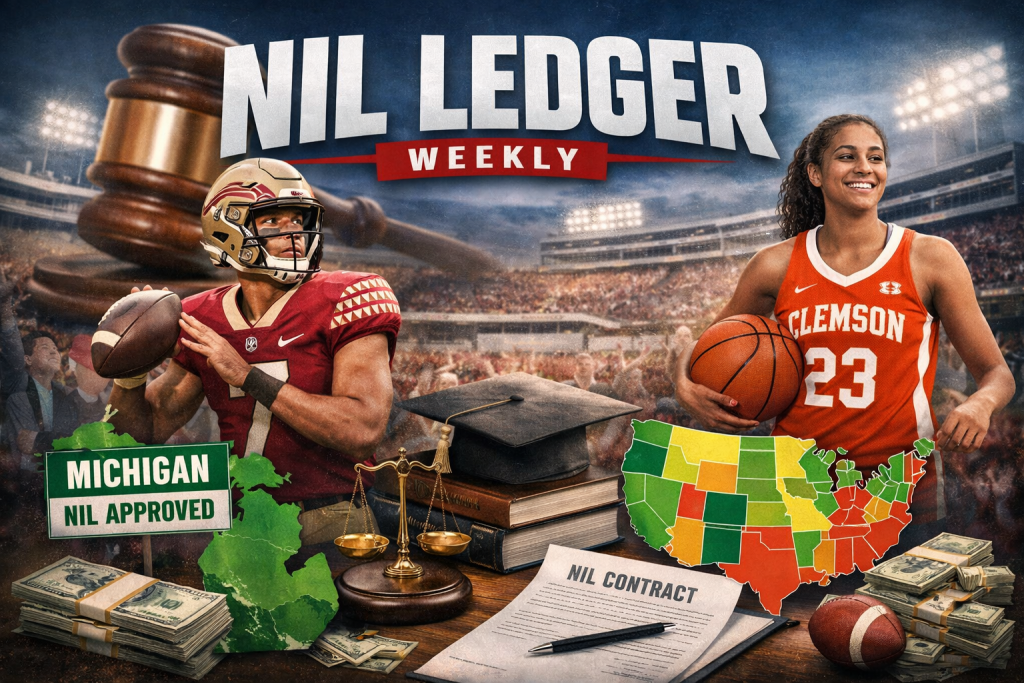
Michigan approved new bylaws allowing high school athletes to enter NIL agreements, effective immediately. Under the policy, athletes may engage in individual branding activities such as social media endorsements, autograph signings, and marketing deals.
Specific guardrails apply. Athletes must disclose NIL agreements at least seven days before acceptance. All agreements must be approved by the Michigan High School Athletic Association. Compensation cannot be tied to athletic performance, recruiting inducements, or enrollment decisions. Collectives, boosters, school employees, and school-organized involvement are explicitly prohibited.
Michigan officials stated that the goal is to allow true individual NIL opportunities while preserving competitive equity. State legislation passed in 2023 paved the way for the rule change.

Alabama considers similar legislation
In Alabama, State Representative Jeremy Gray introduced a bill that would allow high school athletes to sign NIL deals. The proposed legislation would enable high school student-athletes to enter into agreements for endorsements, brand partnerships, and compensation tied to their name, image, and likeness while maintaining the state athletic association’s eligibility requirements.
Lawmakers behind the bill argue it will provide opportunities for young athletes to benefit from their own economic value. Supporters also stress that proper guardrails are needed so younger athletes are not exploited or pressured by early commercial influence.
Public reaction
A recent poll shows mixed public opinion on NIL in high school athletics. Supporters cite fairness and opportunity. Critics raise concerns about the commercialization of minors and uneven resources across schools. As states act independently, the lack of national standards becomes more pronounced.
Amari Bailey and Eligibility Questions
Former UCLA standout Amari Bailey, who played one season at UCLA before entering the NBA draft, is seeking a return to college basketball after playing in 10 NBA games for the Charlotte Hornets.
Bailey has formally hired both an agent and an attorney and is preparing to fight for NCAA eligibility. His legal team, led by lawyer Elliot Abrams, argues that the NCAA has no real justification for denying eligibility based on a small number of minutes in the NBA while on a two-way contract. Bailey told ESPN he began exploring a college return in 2025 and hopes to use a waiver to play another season, emphasizing that he still has one year left in his NCAA eligibility window and feels he has unfinished business on the court.
The NCAA has been resistant to granting eligibility to players who have signed NBA contracts, with senior officials asserting that professional contracts generally disqualify athletes from returning. However, recent prior cases like Charles Bediako’s successful legal challenge have introduced inconsistency in how eligibility rules are enforced.
If Bailey’s waiver is denied, his case is very likely to end up in court as he pursues judicial review, similar to how other recent eligibility disputes have unfolded. That pattern reflects ongoing tension between NCAA eligibility rules and athletes pushing back using legal avenues in the NIL era.
Other Relevant Litigation: Joey Aguilar
Tennessee quarterback Joey Aguilar was previously named in an eligibility lawsuit challenging NCAA rules brought by Diego Pavia. This week, Aguilar was granted a voluntary dismissal and is no longer a plaintiff. Aguilar also hired his own attorney before the dismissal, indicating he will likely pursue another year of eligibility through judicial review rather than remain part of the original lawsuit.
While the dismissal does not resolve the broader legal issues, it reflects the evolving and strategic nature of eligibility litigation. Aguilar’s decision to seek his own legal path illustrates how players and their representatives are increasingly turning to the courts to clarify NCAA eligibility rules in the NIL era.
Other NIL News
Arthur Smith’s arrival as Ohio State offensive coordinator could strengthen the program’s NIL pitch to recruits.
A Clemson women’s basketball player used NIL earnings to surprise her mother with a meaningful trip.
Rutgers announced a NIL partnership with 42U focused on personal branding education.
College sports TV ratings remain strong, with NIL credited for expanding interest across multiple sports.
Oregon quarterback Dante Moore continues to expand his NIL portfolio.
Hollywood Smothers said NIL money was not a major factor in his transfer decision.
Nebraska introduced standardized NIL contract templates to add structure to NIL agreements.
https://www.3newsnow.com/sports/how-transfers-work-with-nil-contracts-at-nebraska
Conclusion
Taken together, this week’s developments show a system still searching for balance. Schools continue to push for stability through contracts and enforcement, while athletes increasingly turn to courts to protect mobility, eligibility, and economic opportunity. From the Mensah settlement to Amari Bailey’s eligibility fight and the expansion of high school NIL, the trend is clear. When rules are applied inconsistently or stretched beyond their legal foundation, litigation fills the gap. Until college sports adopts a framework that matches how the system actually operates, whether through clearer regulation or labor law, uncertainty will remain the defining feature of the NIL era.
Thanks, as always, to everyone for reading the NIL Ledger!